When You Feel Like the Black Sheep in the Family
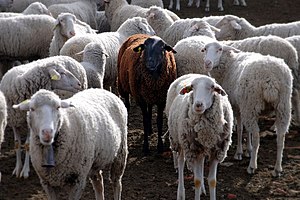
A black sheep stands out from the flock.
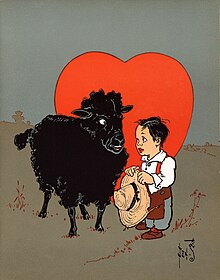
In the English linguistic communication, black sheep is an idiom used to describe a fellow member of a grouping, different from the residual, especially within a family, who does not fit in. The term stems from sheep whose fleece is colored blackness rather than the more mutual white; these sheep stand up out in the flock and their wool was traditionally considered less valuable equally it was not able to be dyed.
In large herds, black sheep are used because they contrast against the mural better than their white siblings. Usually, one blackness sheep accompanies 100 white sheep in a flock of 1,000 or more, then that shepherds tin easily count a flock.[ commendation needed ]
The term has typically been given negative implications, implying waywardness.[one]
In psychology, the black sheep effect refers to the tendency of grouping members to judge likeable ingroup members more positively and deviant ingroup members more negatively than comparable outgroup members.[two]
Origin [edit]
In most sheep, a white fleece is non caused by albinism merely past a common dominant factor that switches color product off, thus obscuring whatever other color that may be nowadays.[ commendation needed ] A black fleece is caused by a recessive factor, and then if a white ram and a white ewe are each heterozygous for black, about one in four of their lambs will exist blackness. In near white sheep breeds, only a few white sheep are heterozygous for black, so black lambs are usually much rarer than this.
Idiomatic usage [edit]
The term originated from the occasional blackness sheep which are built-in into a flock of white sheep. Black wool was considered commercially undesirable because it could non be dyed.[1] In 18th and 19th century England, the black color of the sheep was seen every bit the marker of the devil.[iii] In mod usage, the expression has lost some of its negative connotations, though the term is commonly given to the member of a group who has certain characteristics or lack thereof accounted undesirable by that group.[4] Jessica Mitford described herself every bit "the cherry-red sheep of the family", a communist in a family of aloof fascists.[five]
The idiom is also found in other languages, e.yard. High german, French, Italian, Serbian, Bulgarian, Hebrew, Portuguese, Bosnian, Greek, Turkish, Hungarian, Dutch, Afrikaans, Swedish, Danish, Castilian, Catalan, Czech, Slovak, Romanian and Polish. During the 2d Spanish Republic a weekly magazine named El Be Negre, pregnant 'The Blackness Sheep', was published in Barcelona.[6]
The same concept is illustrated in some other languages by the phrase "white crow": for example, belaya vorona ( бе́лая воро́на ) in Russian and kalāg-e sefīd ( کلاغ سفید ) in Persian.
In psychology [edit]
In 1988, Marques, Yzerbyt and Leyens conducted an experiment where Belgian students rated the following groups co-ordinate to trait-descriptors (east.k. sociable, polite, violent, cold): unlikeable Belgian students, unlikeable North African students, likeable Belgian students, and likeable North African students. The results indicated that favorability is considered highest for likeable ingroup members and lowest for unlikeable ingroup members, with the favorability of unlikeable and likeable outgroup members lying between the two ingroup members.[2] These extreme judgements of likeable and unlikeable (i.e., deviant) ingroup members, relatively to comparable outgroup members is called "black sheep effect". This effect has been shown in various intergroup contexts and under a variety of atmospheric condition, and in many experiments manipulating likeability and norm deviance.[vii] [8] [nine] [ten]
Explanations [edit]

A prominent explanation of the black sheep consequence derives from the social identity approach (social identity theory[11] and self-categorization theory[12]). Group members are motivated to sustain a positive and distinctive social identity and, every bit a consequence, grouping members emphasize likeable members and evaluate them more than positive than outgroup members, bolstering the positive image of their ingroup (ingroup bias). Furthermore, the positive social identity may be threatened by group members who deviate from a relevant group norm. To protect the positive group image, ingroup members derogate ingroup deviants more harshly than deviants of an outgroup (Marques, Abrams, Páez, & Hogg, 2001).[13]
In improver, Eidelman and Biernat showed in 2003 that personal identities are also threatened through deviant ingroup members. They debate that devaluation of deviant members is an private response of interpersonal differentiation.[14] Khan and Lambert suggested in 1998 that cognitive processes such as assimilation and contrast, which may underline the effect, should be examined.[9]
Limitations [edit]
Even though there is wide back up for the blackness sheep issue, the opposite pattern has been found, for example, that White participants judge unqualified Black targets more than negatively than comparable White targets (e.m. Feldman, 1972;[15] Linville & Jones, 1980).[16] Consequently, at that place are several factors which influence the black sheep result. For example, the higher the identification with the ingroup, and the college the entitativity of the ingroup, the more the black sheep effect emerges.[17] [18] Even situational factors explaining the deviance have an influence whether the blackness sheep effect occurs.[nineteen]
equally a projection
To put it more precisely, a "blackness sheep" is an outsider who stands out due to characteristics or behavior that practise not stand for to the ideas or rules that apply and are accepted in the group. This difference is rated as unpleasant by the other grouping members or felt every bit "shameful". In doing and then, people who are different are not only made responsible for their ain beliefs, but also generally blamed for grievances in the group.[two]
In the group dynamic, the "black sheep" in the part of the outsider fulfills an important function every bit a scapegoat. The group strengthens the inner cohesion at the expense of the outsider (bullying). Uncomfortable fearful grouping issues are kept out of the grouping by being projected and personified onto the outsider. The outsider is therefore a carrier of important and valuable energy and can - properly integrated - contribute significantly to the positive development of the grouping and its work.[3]
Run into also [edit]
- Blackness swan theory
- Glossary of sheep husbandry
- Scapegoat
- Baa Baa Blackness Sheep
- The Ugly Duckling
References [edit]
- ^ a b Ammer, Christine (1997). American Heritage Dictionary of Idioms . Houghton Mifflin Harcourt. p. 64. ISBN978-0-395-72774-iv . Retrieved 2007-11-13 .
- ^ a b Marques, J. G.; Yzerbyt, 5. Y.; Leyens, J. (1988). "The 'Black Sheep Issue': Extremity of judgments towards ingroup members as a function of group identification". European Journal of Social Psychology. xviii: 1–16. doi:x.1002/ejsp.2420180102.
- ^ Sykes, Christopher Simon (1983). Blackness Sheep. New York: Viking Printing. p. 11. ISBN978-0-670-17276-4.
- ^ The American Heritage Dictionary of Idioms. Houghton Mifflin Visitor. 1992. Archived from the original on 2008-04-15. Retrieved 2008-03-24 .
- ^ "Red Sheep: How Jessica Mitford found her vox" past Thomas Mallon 16 Oct 2007 New Yorker Archived 6 June 2011 at the Wayback Machine.
- ^ El be negre (1931-1936) - La Ciberniz Archived 2013-02-11 at the Wayback Motorcar
- ^ Branscombe, North.; Wann, D.; Noel, J.; Coleman, J. (1993). "In-group or out-grouping extremity: Importance of the threatened social identity". Personality and Social Psychology Bulletin. nineteen (iv): 381–388. doi:ten.1177/0146167293194003.
- ^ Coull, A.; Yzerbyt, V. Y.; Castano, E.; Paladino, Yard.-P.; Leemans, V. (2001). "Protecting the ingroup: Motivated allocation of cognitive resources in the presence of threatening ingroup members". Grouping Processes & Intergroup Relations. 4 (iv): 327–339. CiteSeerX10.1.1.379.3383. doi:10.1177/1368430201004004003.
- ^ a b Khan, S.; Lambert, A. J. (1998). "Ingroup favoritism versus black sheep effects in observations of informal conversations". Basic and Applied Social Psychology. xx (4): 263–269. doi:10.1207/s15324834basp2004_3.
- ^ Pinto, I. R.; Marques, J. K.; Levine, J. Thousand.; Abrams, D. (2010). "Membership condition and subjective grouping dynamics: Who triggers the black sheep issue?". Journal of Personality and Social Psychology. 99 (1): 107–119. doi:10.1037/a0018187. PMID 20565188.
- ^ Worchel, Southward.; Austin, W. G. (1979). The Social psychology of intergroup relations. Monterey, CA: Brooks-Cole.
- ^ Turner, J. C.; Hogg, Yard. A.; Oakes, P. J.; Reicher, S. D.; Wetherell, M. S. (1987). Rediscovering the Social group: A self-categorization theory. Oxford: Blackwell.
- ^ Hogg, M. A.; Tindale, S. (2001). Blackwell handbook of social psychology: group processes. Malden, Mass: Blackwell.
- ^ Eidelman, S.; Biernat, M. (2003). "Derogating black sheep: Individual or grouping protection?". Periodical of Experimental Social Psychology. 39 (6): 602–609. doi:ten.1016/S0022-1031(03)00042-eight.
- ^ Feldman, J. M. (1972). "Stimulus characteristics and subject prejudice as determinants of stereotype attribution". Journal of Personality and Social Psychology. 21 (3): 333–340. doi:10.1037/h0032313.
- ^ Linville, P. Due west.; Jones, E. E. (1980). "Polarized appraisals of out-group members". Journal of Personality and Social Psychology. 38 (v): 689–703. doi:ten.1037/0022-3514.38.5.689.
- ^ Castano, E.; Paladino, M.; Coull, A.; Yzerbyt, Five. Y. (2002). "Protecting the ingroup stereotype: Ingroup identification and the management of deviant ingroup members". British Journal of Social Psychology. 41 (3): 365–385. doi:10.1348/014466602760344269. PMID 12419008. S2CID 2003883.
- ^ Lewis, A. C.; Sherman, South. J. (2010). "Perceived entitativity and the black-sheep effect: When will we denigrate negative ingroup members?". The Journal of Social Psychology. 150 (two): 211–225. doi:10.1080/00224540903366388. PMID 20397595.
- ^ De Cremer, D.; Vanbeselaere, N. (1999). "I am deviant, considering...: The touch of situational factors upon the black sheep result". Psychologica Belgica. 39: 71–79.
External links [edit]
 | Look up blackness sheep in Wiktionary, the free lexicon. |
- Exploration of the etymology of the phrase "black sheep of the family"
- Marques, José Thou.; José Grand. Marques; Vincent Y. Yzerbyt (1988). "The black sheep effect: Judgmental extremity towards ingroup members in inter-and intra-group situations". European Journal of Social Psychology. 18 (three): 287–292. doi:10.1002/ejsp.2420180308. Retrieved 2008-01-04 .
Source: https://en.wikipedia.org/wiki/Black_sheep
0 Response to "When You Feel Like the Black Sheep in the Family"
Post a Comment